


Premium Coffee Capsules for Office: 2026 Buyer's Guide
Table of Contents
- Premium Coffee Capsules for Office: What Actually Matters
- Coffee Capsule Machine for Office: Matching Pods to Your Brewer
- How to Choose Coffee Capsules for a Shared Break Room
- Office Coffee Capsule Flavors: Roast, Intensity, and Variety
- Coffee Capsules for Shared Office Machines: Compatibility and Etiquette
- Cost Per Cup and Pack Size: The Office Math
- Storage, Replenishment, and Capsule Disposal
- Conclusion: Building a Break Room Coffee Selection That Works
- Frequently Asked Questions
Last Updated: October 7, 2026
Premium Coffee Capsules for Office: What Actually Matters
Most break room coffee fails for one boring reason: the pods sat in a warehouse too long before anyone brewed them. Premium coffee capsules for office use solve that, but only if you know what separates a fresh pod from a stale one.

Capsule quality comes down to three things: how the coffee was sealed, how the filter inside the pod is built, and how recently it was roasted. Get those right and a $2 pod beats a $5 café drink. Get them wrong and no machine on the market will save you.
Freshness, Filter Design, and Why They Decide Cup Quality
Freshness is the single biggest variable in capsule coffee. Oxygen is what kills flavor, so the best capsules are sealed without it, which keeps the grounds from going flat between roast and brew.
Filter design matters just as much. An improved filter spreads water across the whole bed of grounds, so you get a fuller body without a longer brew cycle.
Coffee Capsule Machine for Office: Matching Pods to Your Brewer
The good news for most offices: you probably don't need new hardware. A coffee capsule machine for office use is usually just a standard single-serve brewer, and the pods that fit it are widely compatible. The bad news is that "widely compatible" is not the same as "compatible with your brewer," and that gap is where bulk orders go wrong.
Before you buy 60 pods at a time, run your brewer through a short compatibility check. It takes five minutes and prevents a supply closet full of pods nobody can use.
A Compatibility Check You Can Run in Five Minutes
- Identify the pod format your brewer accepts. Single-serve brewers generally fall into a few families: the standard cup-style pod, the larger commercial pod, and proprietary formats that only accept the manufacturer's own capsules. Your brewer's manual or the label inside the pod holder will name the format.
- Measure the pod holder, not the pod. Pod diameter and depth are what decide fit.
- Check the piercing geometry. Brewers pierce the pod lid from above and sometimes the base from below. If the needle depth doesn't match the pod's lid thickness, you get a partial puncture, which means weak flow and a watery cup.
- Confirm the brew cycle. Some commercial systems run a longer, higher-volume cycle than a home brewer. A pod built for a short cycle can over-extract and turn bitter in a commercial machine.
- Test one sleeve before you commit. Buy a single 12-count, brew it across a full week, and only then place the bulk order.
A Simple Compatibility Matrix
Use this as a starting framework. Fill in your own brewer's specs in the right-hand column before you order.
| Brewer family | Pod format it accepts | What to verify before buying |
|---|---|---|
| Standard single-serve home brewer | Standard cup-style pod | Pod diameter, lid thickness, needle depth |
| Commercial single-serve system | Larger commercial pod | Pod depth, brew cycle volume, water pressure |
| Proprietary closed system | Manufacturer's own capsules only | Whether third-party pods are supported at all |
| Older or discontinued brewer | Varies by model | Replacement pod availability and needle condition |
If your office already runs a standard single-serve brewer, you're set. If you're buying a machine specifically for the break room, prioritize one with a large water reservoir and a fast heat-up time, since those two features decide whether people actually use it during a short break.
When Compatibility Isn't the Problem
Sometimes pods fit but the cup still disappoints. If a pod fits, brews, and still tastes thin, the fix is a better pod, not a new brewer.
How to Choose Coffee Capsules for a Shared Break Room
Choosing capsules for a shared space is a different problem than choosing for yourself. You're buying for a crowd with different tastes, different schedules, and different tolerance for fuss.
Five Criteria That Narrow the List Fast
| Criterion | What to Check | Why It Matters |
|---|---|---|
| Compatibility | Fits your existing brewer model | Avoids returns and wasted packs |
| Roast range | Light through dark available | Covers different palates |
| Pack size | 12-count and 60-count options | Matches your consumption rate |
| Sealing method | Oxygen-free seal stated | Preserves flavor over time |
| Filter design | Even water distribution | Fuller cup, no long brew |
Start with compatibility, then work down. Most offices get stuck on pack size, buying too few and running out midweek, or too many and letting the last dozen go stale.
Office Coffee Capsule Flavors: Roast, Intensity, and Variety
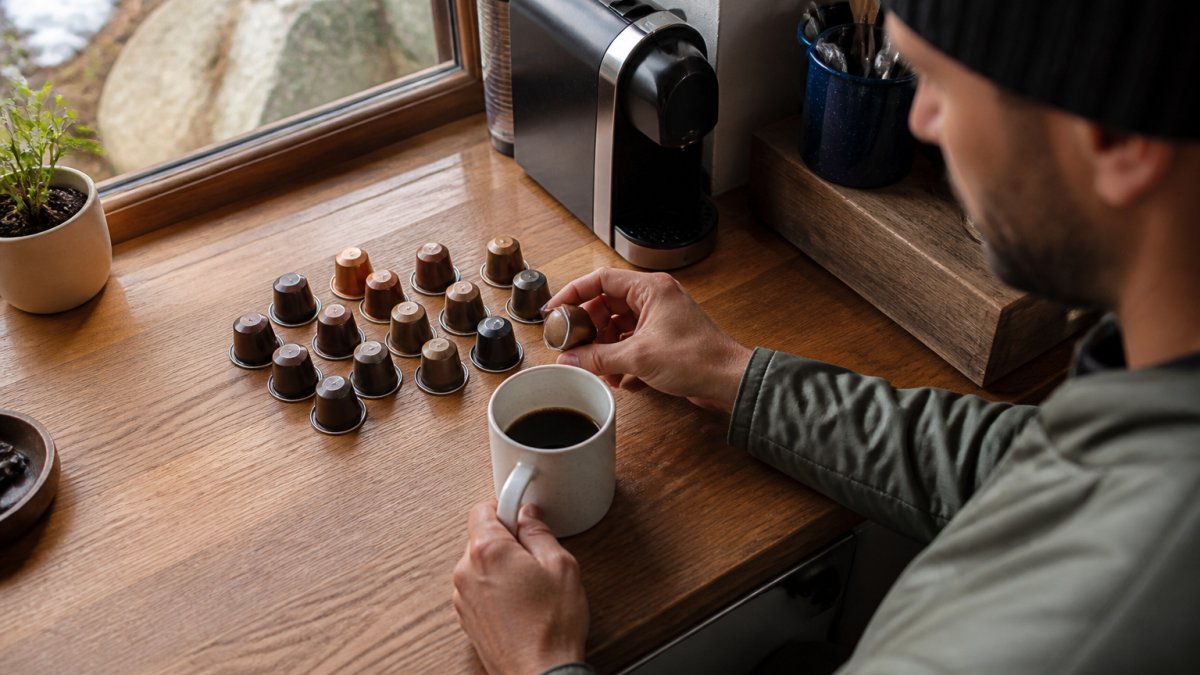
Variety is what keeps a break room stocked with coffee people actually drink. A single roast gets old by week two, no matter how good it is.
Roast level drives most of the flavor differences you'll taste. Medium roasts tend to read as balanced and sweet, while medium-dark and dark roasts push toward chocolate and molasses.
For a shared office, a sensible starting lineup covers three lanes:
- Everyday medium: something smooth enough to drink black
- Bold dark: for people who want a heavier cup
- Something with brightness: citrus or caramel notes for variety
That spread handles most palates without turning your supply closet into a coffee museum.
Coffee Capsules for Shared Office Machines: Compatibility and Etiquette
Coffee capsules for shared office machines create a small social contract. Everyone wants the machine to work, and nobody wants to be the person who leaves it in a state. But before etiquette, the machine has to actually keep up with the room. That's the part most capsule guides skip.

Office-Scale Performance: What to Measure Before You Commit
A brewer that's fine for one person can fall apart at fifteen. These are the numbers that decide whether a shared machine survives a Monday morning.
12 Pack Single Serve Coffee Capsules →
- Throughput. How many cups can the machine brew back-to-back before it needs to recover? A brewer that pauses to reheat between cups will build a line at 9 a.m.
- Water capacity. A small reservoir means someone refills it every hour. Match reservoir size to your daily cup count so refills happen once or twice a day, not constantly.
- Heat-up and recovery time. Fast first-cup time matters less than recovery time between cups. Ask how long the machine takes to return to brew temperature after each cycle.
- Cleaning frequency. Descaling intervals and drip-tray capacity determine how often someone has to do maintenance. A machine that needs daily attention will get neglected.
- Reliability and support. Check the warranty terms, whether replacement parts are stocked domestically, and how quickly support responds. A dead brewer with no local parts is a dead break room.
Etiquette Norms That Actually Hold Up
Once the machine can keep up, a few norms keep it running:
- Restock the pod drawer when you take the last few
- Run a rinse cycle if your office brewer has one
- Report a jam instead of leaving it for the next person
- Keep a backup sleeve of the office's default roast
- Assign one person to own reordering, so it doesn't fall to whoever notices first
None of this is complicated. It just needs one person to set the expectation once.
Matching Capsules to the Machine You Already Have
On the practical side, stick to pods that are confirmed compatible with your brewer. Mixing incompatible capsules is how machines jam, and a jammed machine at 9 a.m. sours the whole floor. If you're unsure, run the five-minute compatibility check above before you place a bulk order.
A shared machine lives or dies on two things: whether it can keep up with the room, and whether the pods you feed it actually fit. Get both right and the etiquette takes care of itself.
Cost Per Cup and Pack Size: The Office Math
Cost per cup is where premium capsules earn their keep, and it's the number most buyers never calculate.
Take our 60 Pack Single Serve Coffee Capsules at $79.99. That works out to roughly $1.33 per cup, which is well under what most people pay for a café drip coffee. Our 12 Pack Single Serve Coffee Capsules runs $21.99, or about $1.83 per cup, which makes sense as a trial size rather than a standing order.
Here's how our lineup breaks down:
| Product | Count | Price | Approx. Cost Per Cup |
|---|---|---|---|
| 12 Pack Single Serve Coffee Capsules | 12 | $21.99 | $1.83 |
| 60 Pack Single Serve Coffee Capsules | 60 | $79.99 | $1.33 |
| Mexico Coffee Pods | 12 | $24.99 | $2.08 |
| Peru Coffee Pods | 12 | $24.99 | $2.08 |
| Bali Coffee Pods | 12 | $24.99 | $2.08 |
The math is simple: bigger packs lower your per-cup cost, so the 60-count is the workhorse for a busy break room while the 12-counts let you test a single origin before committing.

Storage, Replenishment, and Capsule Disposal
Storage and disposal are the two things offices forget until they become a problem. Both are easy to get right.
Keep capsules in a cool, dry spot away from the brewer's heat. Heat and moisture are what degrade a pod's seal over time, so a cabinet beats a shelf above the machine.
For replenishment, track your consumption for two weeks before setting a reorder point.
Disposal depends on your local waste rules. Check what your municipality accepts before you promise the team a green solution. Either way, decide before you buy in bulk, not after.
Conclusion: Building a Break Room Coffee Selection That Works
A break room coffee program lives or dies on three decisions: fresh, well-sealed capsules, a lineup that covers more than one palate, and a pack size that matches your actual consumption. Nail those and the machine pays for itself in goodwill.
Ridgeline Trail & Coffee builds its capsules around exactly that. Our Original Roast blend is sealed without oxygen to stay fresh, and the improved filter keeps water from rushing through the middle for a fuller cup. The single-origin Mexico, Peru, and Bali pods give your team real variety without a second machine.
Frequently Asked Questions
Are coffee capsules compatible with every single-serve machine?
No. Most single-serve brewers, including Keurig systems, accept standard pod formats, but some machines use proprietary capsule shapes that only work with that brand's pods. Check your brewer's accepted format before buying in bulk. The 12 Pack and 60 Pack Single Serve Coffee Capsules, along with the Mexico, Peru, and Bali pods, are listed as working with Keurig and other single-serve pod brewers, which covers most shared office machines.
How do you choose coffee capsules for a shared office?
Start with machine compatibility, then match pack size to headcount. A 12-capsule pack suits a small team testing a new roast; a 60-capsule pack fits a busier break room with daily coffee drinkers. Offer at least one medium roast and one darker option so both light and bold preferences are covered, and keep unopened packs sealed until needed to protect freshness.
Which coffee capsule flavors work well for different office preferences?
Medium roasts with caramel and citrus notes, like the Peru pods, tend to please a broad range of drinkers. Darker profiles such as the Bali pods, with dark chocolate and molasses, suit those who take milk or want a bolder cup. Single-origin options like the Mexico pods add variety for anyone who wants something distinct from a standard house blend.
How should an office store coffee capsules to keep them fresh?
Keep capsules sealed in their original packaging until use, since oxygen exposure is what dulls flavor over time. Store them in a cool, dry cabinet away from the brewer's heat and direct sunlight. Rotate stock so older packs get used first, and avoid transferring pods into open bins, which exposes them to air and moisture long before brewing.